Landing page SEO means building a landing page so it ranks in Google for a specific search and then turns those visitors into enquiries or bookings. Pick one keyword that matches what the searcher wants, answer it on the page in plain words, and make the next step obvious. Then get the basics right. That means a clear title and URL, fast loading on mobile, and links to the page from the rest of your site.
Below are the landing page SEO best practices we use, in the order we’d tackle them, plus how SEO landing pages differ from campaign pages for PPC and email. You’ll find a checklist you can use on your own pages too.
What is an SEO landing page?
A landing page is any page a visitor lands on first. In marketing, it usually means a page with one goal, like booking a stand, registering for an event or requesting a quote.
An SEO landing page is one built to be found through organic search. It targets a keyword people actually type in, it has enough useful content to earn a ranking, and it still has one clear next step. A PPC landing page, by contrast, gets its traffic from paid campaigns, so it can be short and doesn’t need organic visibility at all.
| SEO landing page | PPC or email campaign page | |
|---|---|---|
| Traffic source | Organic traffic, AI answers and internal links | Paid campaigns, social or email |
| Content | Enough copy to answer the query fully | Short and focused on the offer |
| Lifespan | Long term, improved over time | Often just the length of the campaign |
| Best for | Each service, product or location you sell all year | Launches, early bird deals and short promotions |
| Indexing | Indexed and linked from your site | Often set to noindex if it duplicates another page |
If you run near-identical PPC pages for different campaigns, Google’s noindex guidance shows how to keep them out of the results so they don’t compete with your main page. That’s a sensible SEO strategy for any business running ads and organic side by side.
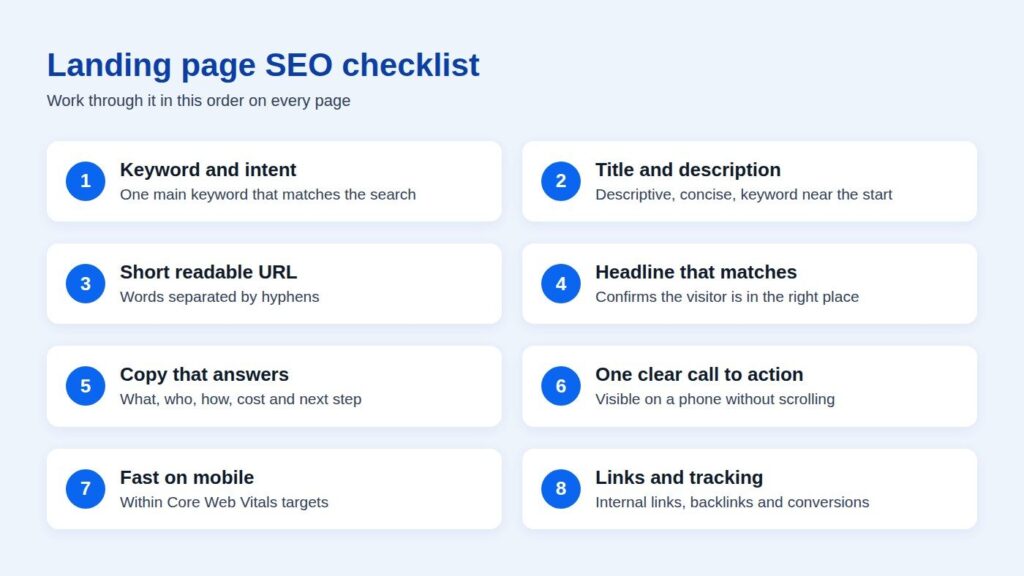
Landing page SEO best practices checklist
These are the best practices for landing pages that work for any business, whether you’re promoting a show, a service or a product.
1. Focus on keyword research and search intent
Choose one main keyword for each landing page, plus a few close variations. Then look at what already ranks for it. If the top results are guides, a sales page will struggle. If they’re service pages, a blog post won’t fit. Matching intent matters more than the exact keyword. Our guide to keyword research walks through the tool options and the process.
2. Write a clear title tag and meta description
Your title is the first thing a searcher sees. Google’s title link guidance asks for descriptive and concise titles and warns against keyword stuffing. Put the keyword near the start and say what the page offers.
The meta description supports the title. Google says it primarily builds snippets from the page content, and sometimes uses the meta description when it describes the page better. Write one anyway. It’s your best chance to catch the eye and earn the click.
3. Keep the URL short and readable
Google’s URL structure guidance recommends readable words rather than long ID numbers, with hyphens between them. So /exhibitor-booking/ beats /page?id=4821. Once a page has rankings, don’t change its address without a 301 redirect.
4. Make the headline match the query
The H1 should confirm straight away that the user is in the right place. Use the keyword, or something very close to it, and lead with the benefit. A compelling headline that echoes the query keeps people reading instead of hitting the back button.
5. Fine tune your copy for the reader and the topic
This is where most landing pages fall short for SEO. A page with a headline, a form and three bullet points rarely ranks. A good landing page answers the questions your audience has before they’ll act. Cover what’s included, who it’s for, how it works, what it costs or how to get a quote, and what happens next.
Keep it easy to scan. Short paragraphs, clear subheadings and a short FAQ section help readers, Google and AI answers alike, and cover the topic properly. Our AI search optimisation page explains how the same structure helps you get cited in AI answers.
6. Use one clear call-to-action button
Every effective landing page has one main goal. Put the button where people can see it on a phone without scrolling, and repeat it lower down. Say what happens when they click, like “Book your stand” rather than “Submit”. Our CTA statistics show how much small wording changes can matter to your conversion rate.
7. Boost your landing page performance on mobile
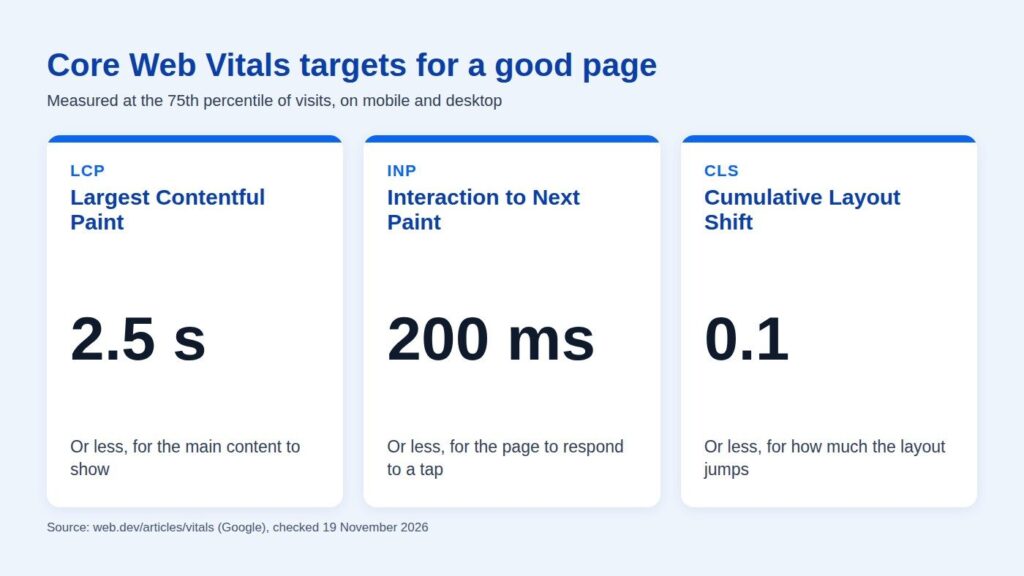
Google completed mobile-first indexing in 2023, so the mobile version of your page is what counts. The Core Web Vitals on web.dev set the speed targets. The main content should load within 2.5 seconds, taps should get a response within 200 milliseconds and layout shift should stay at 0.1 or less. Compress photos, cut heavy scripts so the page can load fast, and test on a real phone. Our Core Web Vitals guide goes deeper.
8. Add descriptive alt text
Search engines can’t see your pictures, so describe them. When a picture is a link, Google uses its alt text as the anchor text. Name files properly too, like stand-booking-floor-plan.jpg, not IMG_4821.jpg.
9. Link to your landing page from relevant pages
Internal links tell Google a page matters and help visitors find it. Add them from related service pages, articles and your menu where it fits, using descriptive anchor words rather than “click here”.
10. Build a few quality backlinks
A backlink from a relevant, trusted site is still one of the strongest signals a landing page can get. Partners, sponsors, venues, industry associations and local press are natural sources for events and B2B pages. Our guide to backlinking explains how to earn them, and our link building team can do it for you.
Tracking conversion and testing your landing page
You can’t improve what you don’t measure. Track three things on every SEO landing page. First, the queries it appears for and its clicks, in Google Search Console. Second, how visitors behave, in Google Analytics. Third, the conversion itself, as a key event in GA4, so you know your conversion rate and can drive more of what works. Our analytics and tracking setup gives you that insight from day one.
Once traffic is flowing, keep testing one change at a time, such as the headline, the button wording or the number of form fields. Give each test long enough to get real results before you decide. The same applies to restaurant and venue booking pages, where removing friction from the booking step usually matters more than any design tweak.
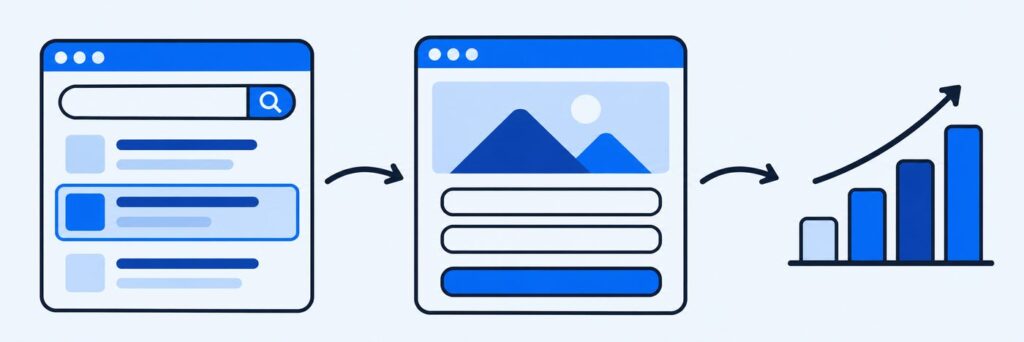
Common questions about landing page SEO
Can a landing page rank on Google?
Yes, if it targets a real query, has enough useful content and is linked from the rest of your site. Thin pages with just a form and a headline rarely do well, so add the detail people need before they act.
Should a landing page be indexed?
SEO landing pages should be. Short-term campaign pages that duplicate another page, or exist only for ads and email, are often better set to noindex so they don’t compete with your main page.
What does landing page mean in digital marketing?
It’s a page built for one goal that visitors land on from a specific source, like an ad, an email, a social post or a search result. The aim is to turn that visit into a lead, a booking or a sale.
What is the 80/20 rule in SEO?
It’s the idea that a small share of your pages and fixes brings most of the results. For landing pages, that usually means getting the keyword, the title, the content and the next step right before worrying about anything else. Those are the SEO tips that pay off first.
Need to create landing pages that rank and convert?
Our landing page design service builds pages for campaigns, launches and events that load fast and are built to convert, with tracking from day one. Not sure why your current pages aren’t performing? Our free website audit checks speed, SEO and tracking, and tells you in plain English what to fix first.