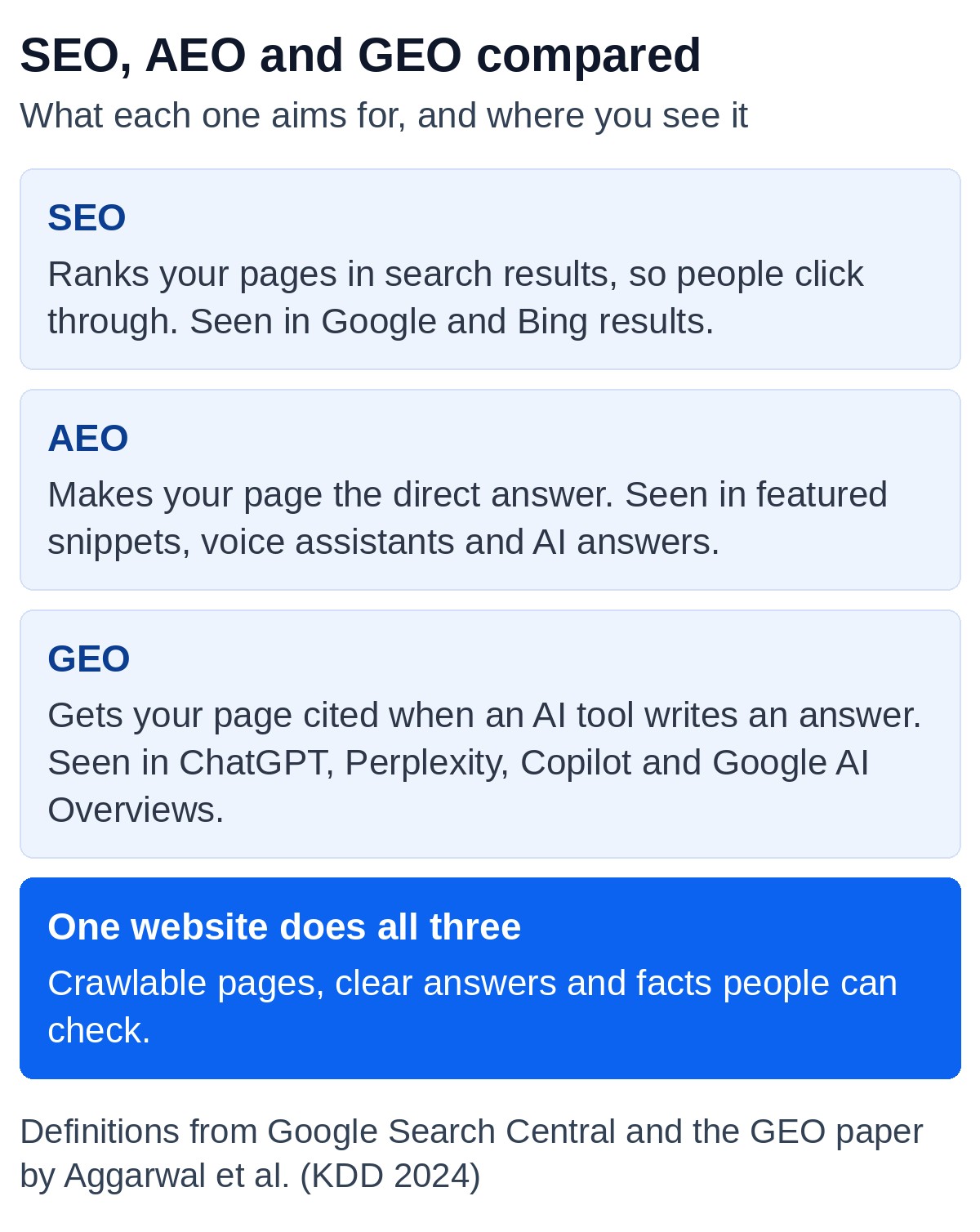
GEO vs SEO vs AEO comes down to where your website shows up. SEO (search engine optimisation) gets your pages ranked in Google and Bing so people click through. AEO stands for answer engine optimisation, which shapes a page so a search engine or assistant can lift a direct answer from it. GEO (generative engine optimisation) aims to get your page cited when an AI tool such as ChatGPT, Perplexity or Google’s AI Overviews writes a response.
For a marketing team without its own developer, the honest view is that these are three names for overlapping work on the same website, not three separate jobs. You don’t need three agencies or three budgets. You need pages that search engines can reach, that deal with real questions clearly and that carry facts people can check. This guide explains how they differ, what actually changes for your website and which work to pay for first.
Traditional SEO, AEO and GEO at a Glance
Traditional SEO wins the click from a list of results, AEO wins the direct answer and GEO wins a citation inside an AI-written response. All three aim to make you the source people and machines trust when your buyers search.
| Approach | What it aims for | Best for |
|---|---|---|
| SEO | Ranking pages in Google and Bing search results so people click through | Every website, because AEO and GEO both depend on it |
| AEO | Being the direct answer in featured snippets, voice assistants and AI summaries | Pages built around clear questions, such as prices, steps and comparisons |
| GEO | Being cited when ChatGPT, Perplexity, Copilot or Google’s AI features write a response | Brands that buyers compare and research before they enquire |
What Is the Difference Between SEO, AEO and GEO?
The difference between SEO, AEO and GEO is the kind of search result each one targets. Traditional SEO focuses on ranking a whole page. AEO focuses on a short, self-contained reply that can be shown or read out on its own. GEO focuses on being one of the sources an AI tool reads, summarises and links to.
Search engine optimisation is the oldest and broadest of the three. It covers everything that helps search engines find, understand and rank your pages, from technical health and site speed to content, links and authority.
AEO grew up around featured snippets and voice assistants, where a search engine or smart speaker gives one reply rather than a list. It’s mostly about structure. A clear question as a heading, the direct answer underneath and lists or tables that can be lifted as they are.
GEO is the newest term. It comes from a 2023 research paper on generative engine optimisation by researchers at Princeton and partner institutions, which found that adding citations, quotations and statistics to a page could raise its visibility in generative engine responses by up to 40%. The same idea now applies to AI search tools, which read several relevant pages and write one response.
You’ll also see AI SEO and LLM SEO used for the same goal. Honestly, the labels matter far less than whether the work changes your website.
GEO vs SEO and What Generative Engine Optimisation Needs
SEO is the foundation and GEO is what you build on top of it. An AI tool can only cite a page it has found, and most of them find pages through a search index. So GEO without strong SEO rarely works, while a good SEO strategy already does a lot of that work for you.
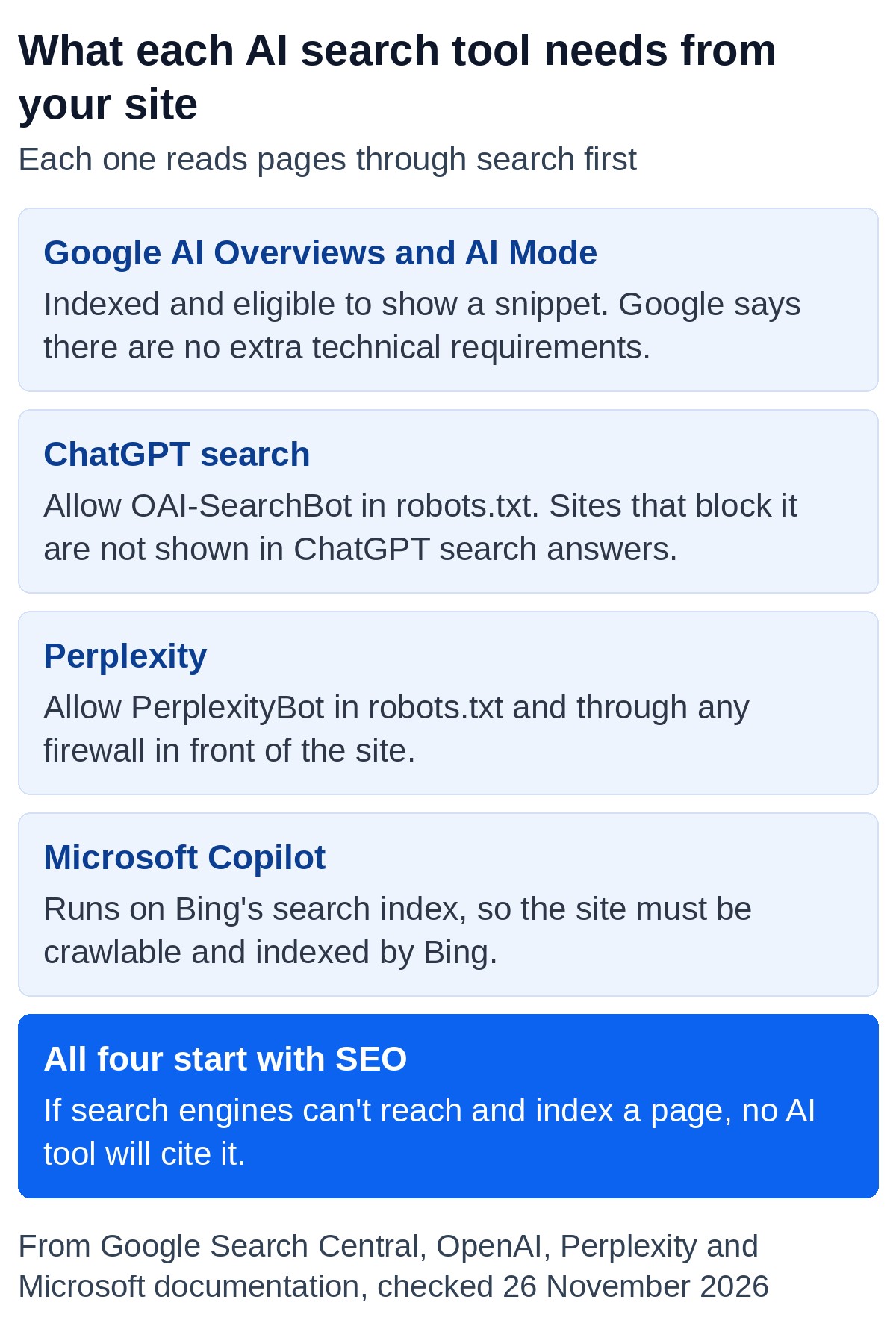
Google is very direct about this. Its guide to AI features and your website says a page must be indexed and eligible to show with a snippet to appear as a supporting link in AI Overviews or AI Mode, and that “there are no additional technical requirements”. The same page says AI Overviews and AI Mode may run several related searches across subtopics to build one response, so a page that ranks for a narrower question can still be pulled in.
The other AI search engines also work through search first.
- ChatGPT search uses its own crawler. OpenAI’s crawler documentation says sites that opt out of OAI-SearchBot will not be shown in its search results.
- Perplexity recommends allowing PerplexityBot in robots.txt and in any firewall in front of the site, in its crawler guide.
- Microsoft Copilot is powered by Bing’s search index, according to Microsoft’s guidance on AI search, which also says crawlability, metadata, internal linking and backlinks remain essential.
Where GEO helps is in what happens after the page is found. Microsoft says AI assistants break a page into smaller pieces and rank those pieces for authority and relevance, rather than ordering whole pages. So a page with one clear point per section, real figures and named sources gives an AI tool something worth quoting. A page of general claims gives it nothing.
Best for GEO work is a business that already ranks reasonably well but finds AI tools naming its competitors instead. Anyone whose pages aren’t indexed or don’t rank yet should start with the search basics. Our technical SEO service covers that base.
AEO vs SEO and What Answer Engine Optimisation Adds
AEO is a way of writing and structuring pages, and SEO is the wider job that gets those pages seen at all. AEO focuses on a clear, direct answer that can stand on its own, so it can be shown as a featured snippet, read out by an assistant or lifted into an AI summary.
Microsoft’s guidance says direct questions with clear replies mirror the way people search, and that assistants can often lift those question and answer pairs word for word into AI responses. That’s AEO in practice, and why our own articles open with the point.
AEO is closely tied to spoken search, because a smart speaker reads one reply out loud rather than showing ten links. If that matters to your buyers, our guide to voice search SEO covers the current UK figures and what helps.
Best for AEO is any page built around a question buyers actually ask, such as what something costs, how long it takes or which option suits them. It isn’t a separate service. It’s how the content on your service pages should be written in the first place, and it helps most on pages that already rank.
AEO vs GEO and Where They Overlap
These two are the closest of the three, and in practice GEO and AEO are mostly the same work. One was named for featured snippets and assistants, the other for AI tools that write a full response, but both reward pages that make one clear point per section and back it up.
The small gap is scope. AEO is about the single best reply to one question. Generative engine work also cares about how often your brand is mentioned and trusted across the web, because AI tools weigh authority as well as relevance when they pick what to quote. So asking whether you need AEO or GEO is a bit like asking whether you need headings or paragraphs. A page that does one well usually does the other.
Is GEO Replacing SEO?
No, SEO is still the base. AI tools lean on the same pages that rank in search, and the sources they cite overlap heavily with normal results. What is changing is how people click, so the way you measure success has to change too.
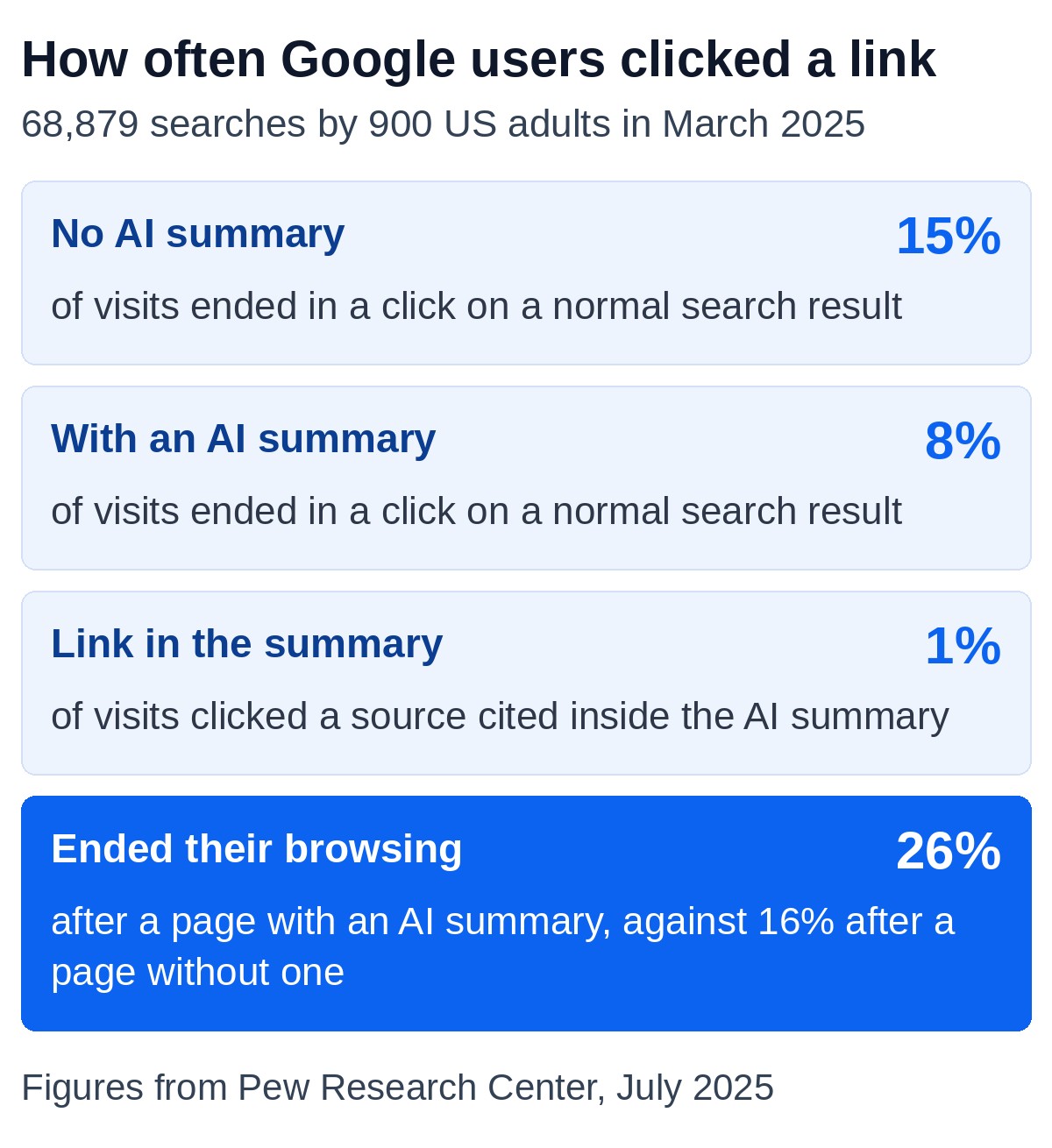
A study by Pew Research of 68,879 Google searches made by 900 US adults in March 2025 found that users clicked a normal search result in 8% of visits when an AI summary appeared, against 15% when it didn’t. They clicked a link inside the AI summary itself in just 1% of visits.
The same study found Wikipedia, YouTube and Reddit were the most cited sources in both AI summaries and standard results. That’s a good sign the two draw on the same pool of trusted pages, rather than AI search running on its own separate rules.
So SEO remains what decides whether you’re in the pool. The newer work decides how often you’re picked from it and named. What changes for your reporting is that fewer clicks don’t always mean less visibility. Pages that appear in AI Overviews and AI Mode are counted inside the normal Search Console performance report, and visits from AI tools can be tracked separately in Google Analytics. We set that up as part of our analytics and tracking work.
What’s Changing for Your Website’s Visibility
Less changes for your website than most AI search pitches suggest. The work is mostly the fundamentals done properly, with a few habits that make your pages easier for AI tools to quote. Here’s what we’d check first on any site.
- Let the right crawlers in. Googlebot, Bingbot, OAI-SearchBot and PerplexityBot should all be able to reach your pages, through robots.txt and any security plugin or firewall. A firewall that blocks unfamiliar bots can keep a site out of AI search even when it’s fine in normal results.
- Lead with the point. Open each page and each section with the direct answer, then back it up. A good page deals with its main question in the first two or three sentences.
- Use facts that can be checked. Real prices, dates, steps and sourced figures give an AI tool something to cite. Vague claims give it nothing.
- Keep structured data honest. Google’s advice for its AI experiences in Search is to make sure structured data matches the visible content on the page.
- Show who you are. Named authors, real case studies and consistent company details build the authority both search engines and AI tools look for.
- Measure AI visits. Track referrals from AI tools in your analytics, so the work is judged on real visits and enquiries across every channel.
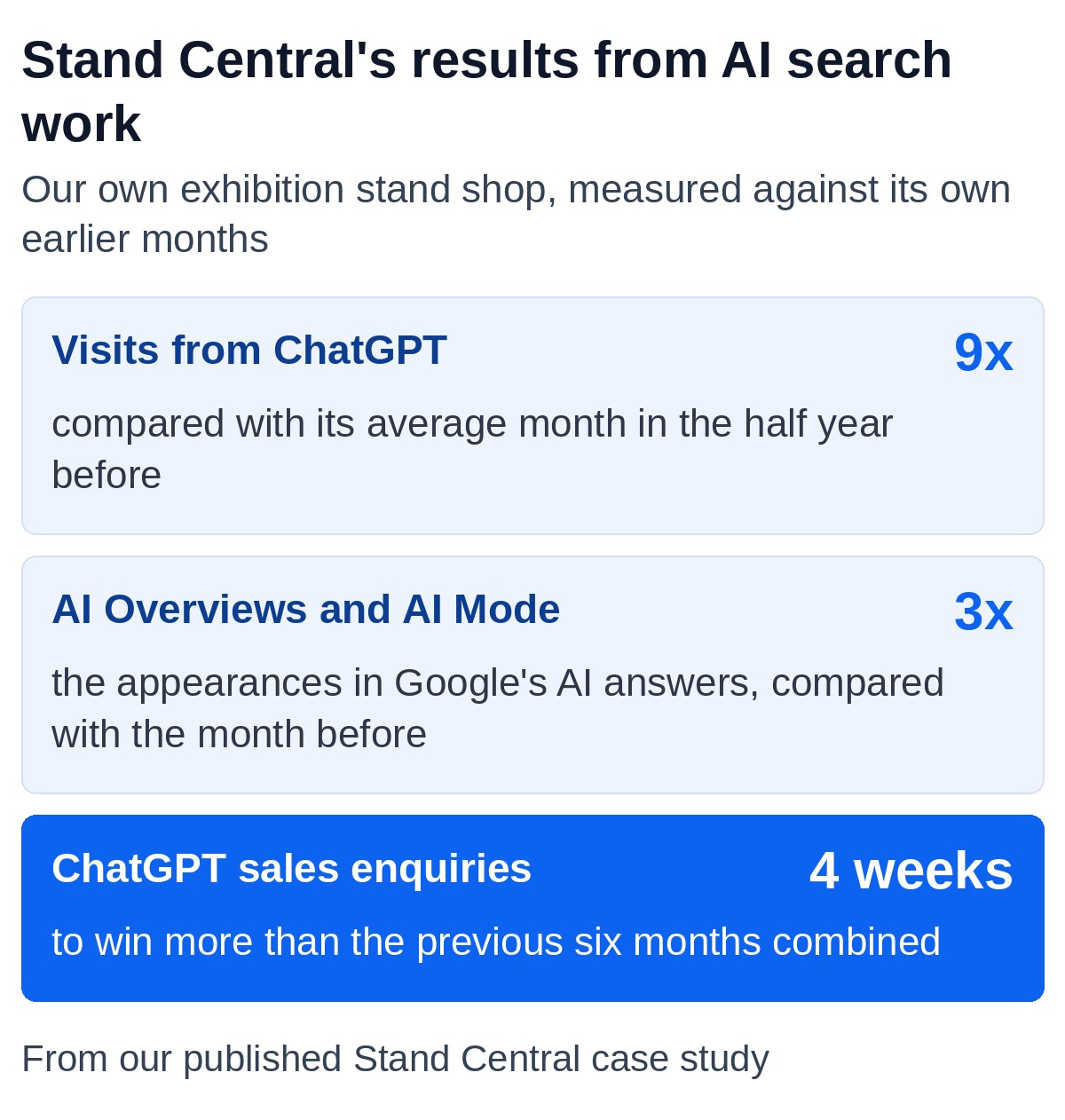
This is the same work we run on our own businesses. On Stand Central, our exhibition stand shop, it brought 9x the visits from ChatGPT compared with its average month over the half year before. It also took 4 weeks to win more sales enquiries from ChatGPT than in the previous six months combined, as set out in our Stand Central case study.
If you want this done for you, our generative engine optimisation service covers the AI side alongside the search work it depends on.
Which Work Your Brand Should Pay For First
Pay for SEO first if your important pages aren’t indexed or don’t rank, and add the AI work to your strategy once they do. Most teams don’t need to choose between SEO and GEO, or SEO and AEO, because one well-run piece of work on the right pages covers all of them.
- If key pages are missing from search results, fix the search basics first. No AI tool can cite a page it can’t find.
- If you rank but AI tools name other businesses, rewrite your key pages to lead with facts worth quoting. That’s the answer engine and generative engine work.
- If you’re already named by AI tools, track AI visits and enquiries, keep your facts current and widen the questions you cover.
- If someone offers these as three separate packages, ask what each one changes on your website. If the work overlaps, you’d be paying twice for the same thing.
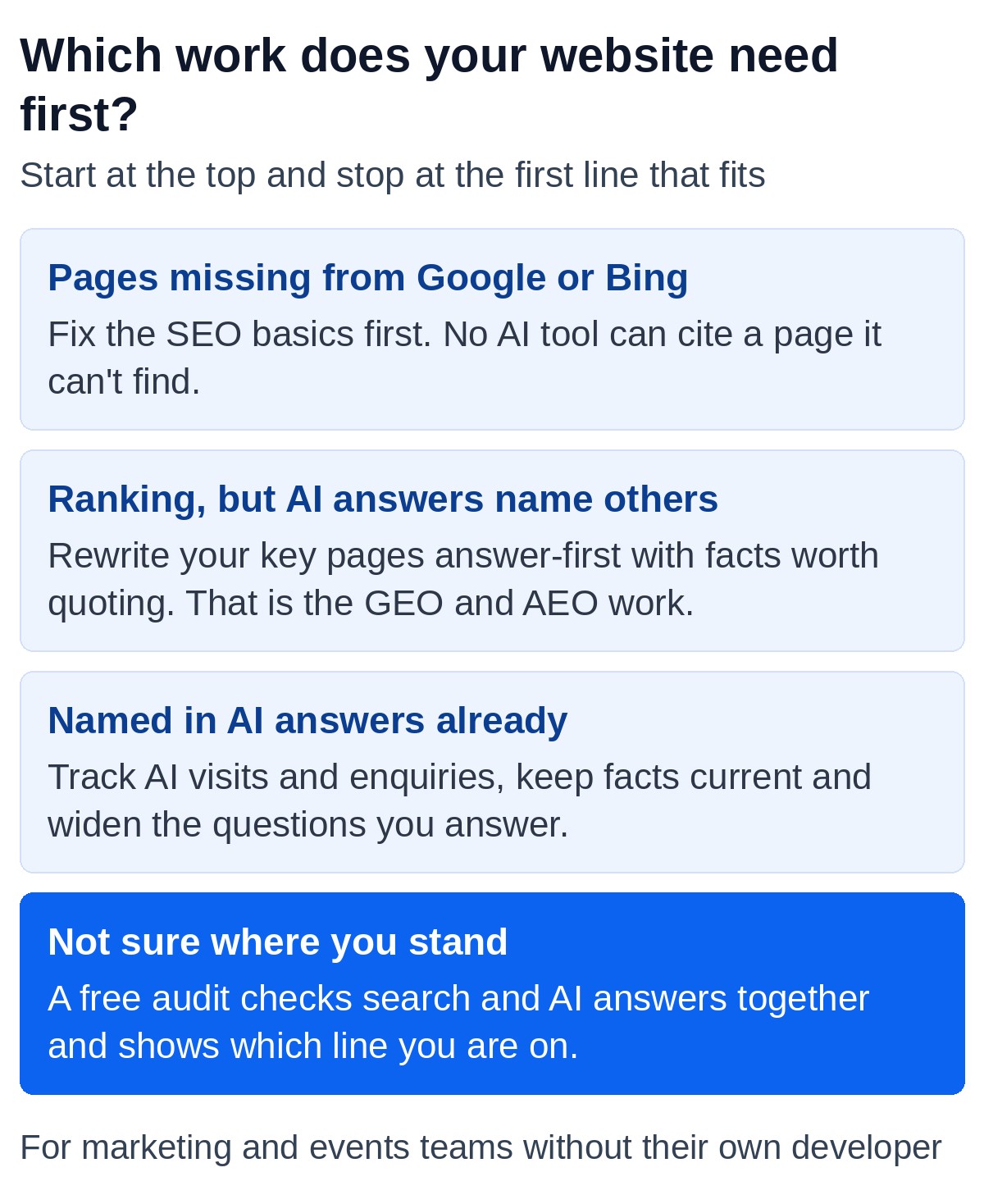
Not sure which of those fits you? Our free website audit checks your search visibility and asks AI tools the questions your buyers ask, then shows you where you stand, within one working day.
How We Compared
This is a desk comparison of the three approaches on what each aims for, what it needs from a website and how it’s measured, checked on 26 November 2026. Sources were the official documentation from Google, OpenAI, Perplexity and Microsoft, the original GEO paper, Pew Research’s study of Google searches and our published Stand Central case study.
Frequently Asked Questions
Is AEO part of GEO?
They overlap a lot. AEO is about clear, direct replies that a search engine or assistant can lift, and GEO is about being cited in AI-written responses. Clear, self-contained points are one of the main things that get a page cited, so in practice good AEO is a large part of GEO.
Is AEO better than SEO?
No, AEO isn’t better than SEO, because it can’t work without it. AEO helps a page that’s already found. It doesn’t get it found. Think of it as the way you write and structure content on pages that search has already made visible to users.
Do I need a separate GEO agency as well as an SEO agency?
Usually not. Google says its AI features need nothing beyond normal SEO, and other AI tools also find pages through search. One team that handles technical work, clear content and AI visibility tracking together avoids paying twice for overlapping work.
How do I know if ChatGPT mentions my business?
Ask the main AI tools the questions your buyers ask, in their own words, and note which businesses each reply names. Then check Google Analytics for visits referred from those tools. Our free website audit includes this check alongside the technical review.