If you’re weighing up an in-house web developer vs agency support for a marketing team, the agency is usually the faster and much cheaper way to get landing pages, form fixes and campaign changes live. The median advertised UK salary for the role is £47,500, which comes to about £55,100 a year once employer National Insurance and pension are added, and that buys one person who takes holidays, gets ill and will one day leave. Go in-house when there’s a full week of development work every week, or when the website is the product your business sells.
In-House Web Developer vs Agency at a Glance
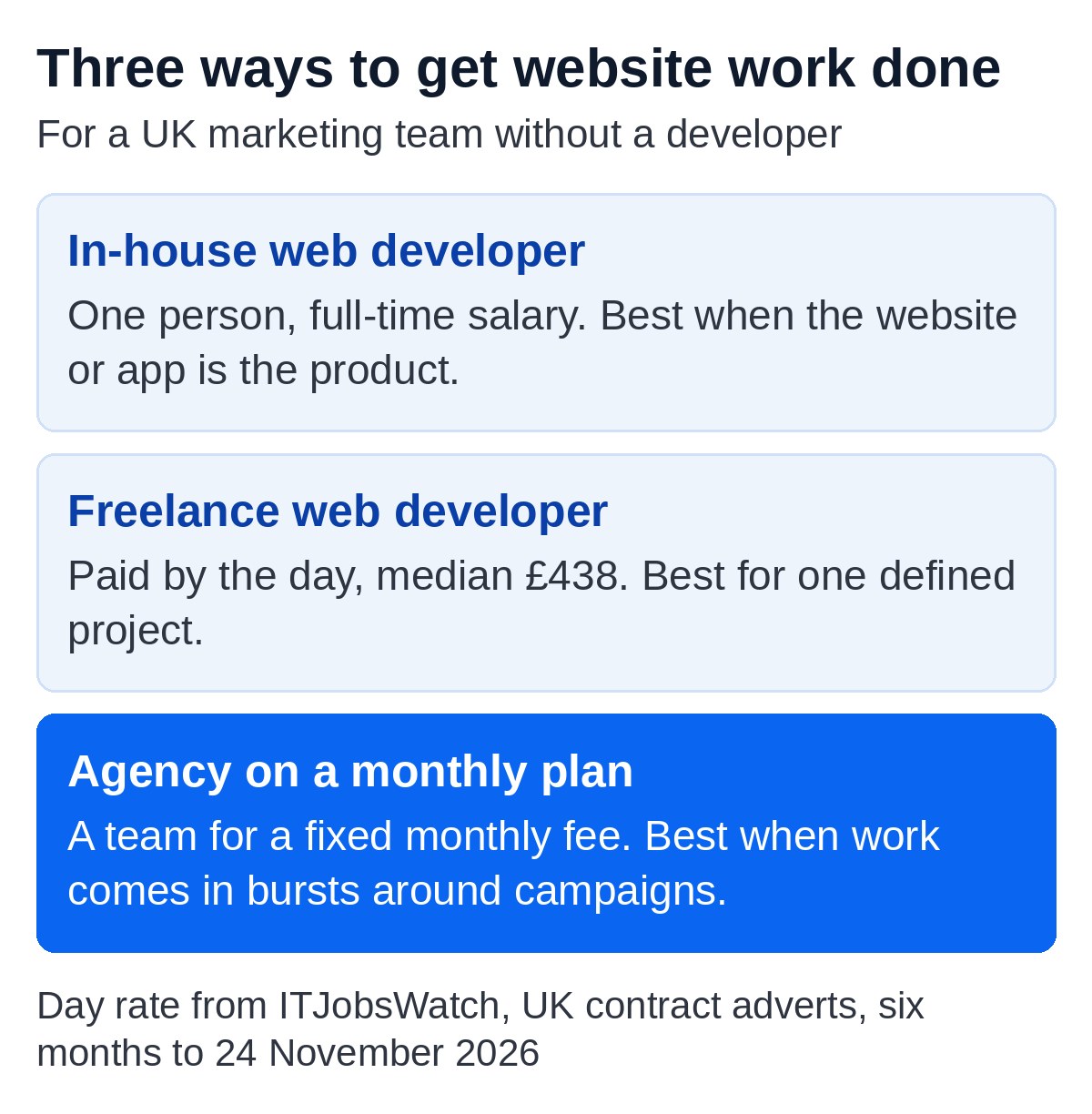
In-house development gives you one person’s full attention at a full-time price. A development agency gives you a group of people who already handle this work every day, for a monthly fee, with far less of your own time spent on management. You give up a little day-to-day control and get a lot more cover.
| Option | Price | Best for |
|---|---|---|
| In-house hire | About £55,100 a year at the median rate, before equipment, software and recruitment | Businesses with a constant development backlog, or where the website or app is the product |
| Freelancer | A day rate, with a UK median of £438 a day for contract work | Project-based work with a clear brief and a deadline that isn’t tight |
| Agency, paid monthly | A fixed monthly fee, ours from £150 to £750 a month plus VAT | Work that comes in bursts around campaigns, launches and events |
The Real Cost of Hiring In-House Developers
One person on a median UK salary costs a business about £55,100 a year before you’ve bought them a laptop or paid a recruiter. The pay itself is only the starting point.
Over the six months to 24 November 2026, the median salary in UK job adverts for the role was £47,500, according to ITJobsWatch. WordPress roles had a lower median of £38,750, though from far fewer adverts.
On top of that, the employer owes National Insurance at 15% on earnings above £5,000 a year, which is £6,375 on £47,500 under HMRC’s rates for 2026 to 2027. Under automatic enrolment the employer must also put at least 3% into a workplace pension, worked out on earnings between £6,240 and £50,270, which is another £1,237.80 (see GOV.UK’s pension contribution rules).
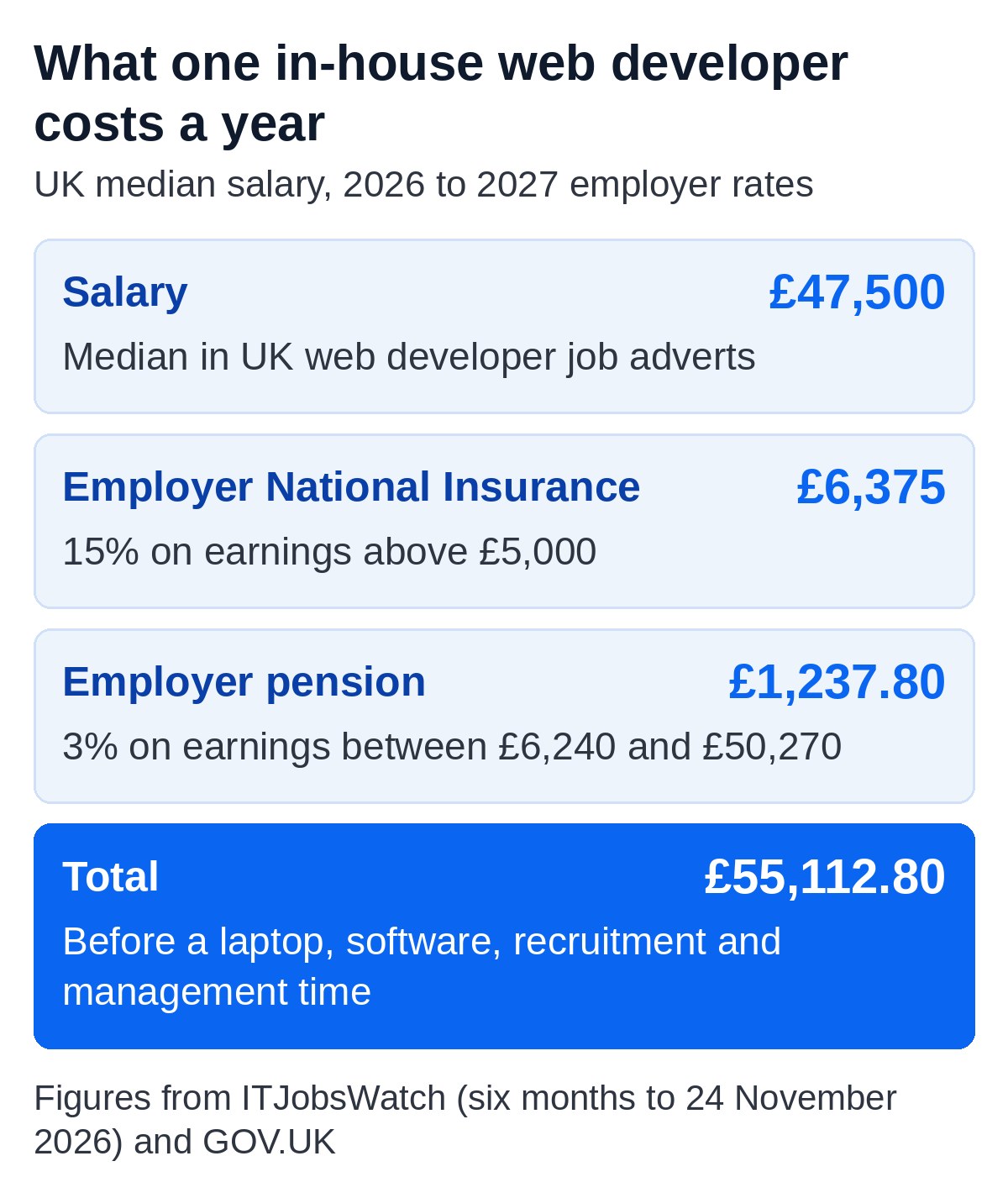
That’s £55,112.80 a year. Smaller employers may be able to claim Employment Allowance, which reduces the employer National Insurance bill by up to £10,500 a year, but the allowance is for your whole payroll, so if you already employ people some or all of it may be used up. There’s also the effort of recruiting and managing someone when nobody internal can check their work.
In-House vs Outsourced Web Development Costs Side by Side
Over a year, outsourcing your web development to an agency on a monthly plan comes to a fraction of an in-house hire. Our Team plan is £750 a month plus VAT, which over twelve months is less than a fifth of the figure above.
To be fair to the in-house option, the comparison isn’t like for like. A full-time employee gives you a whole working week of one person’s time. Our Team plan covers the regular changes a busy marketing or events department makes each month, plus hosting, backups, security, updates and connections to your CRM and booking tools, within fair use. A new website or a new piece of software is a separate web development project we quote first. So if your business genuinely has a full-time development workload, the gap closes. If the work comes in bursts, you’d be spending money on a lot of quiet weeks.
Speed, Cover and Control With an In-House Hire or an Agency
An employee is quickest on the days they’re in and not tied up with another task. An agency is more consistent across the whole year, because more than one person has a working understanding of your site and can pick up the job.
Almost all workers in the UK are entitled to 5.6 weeks of paid holiday a year, which is 28 days for someone working five days a week. Add sickness, training and the weeks it takes to replace someone who leaves, and there will be times your only technical person isn’t there when the campaign has to go live. That’s a real risk.
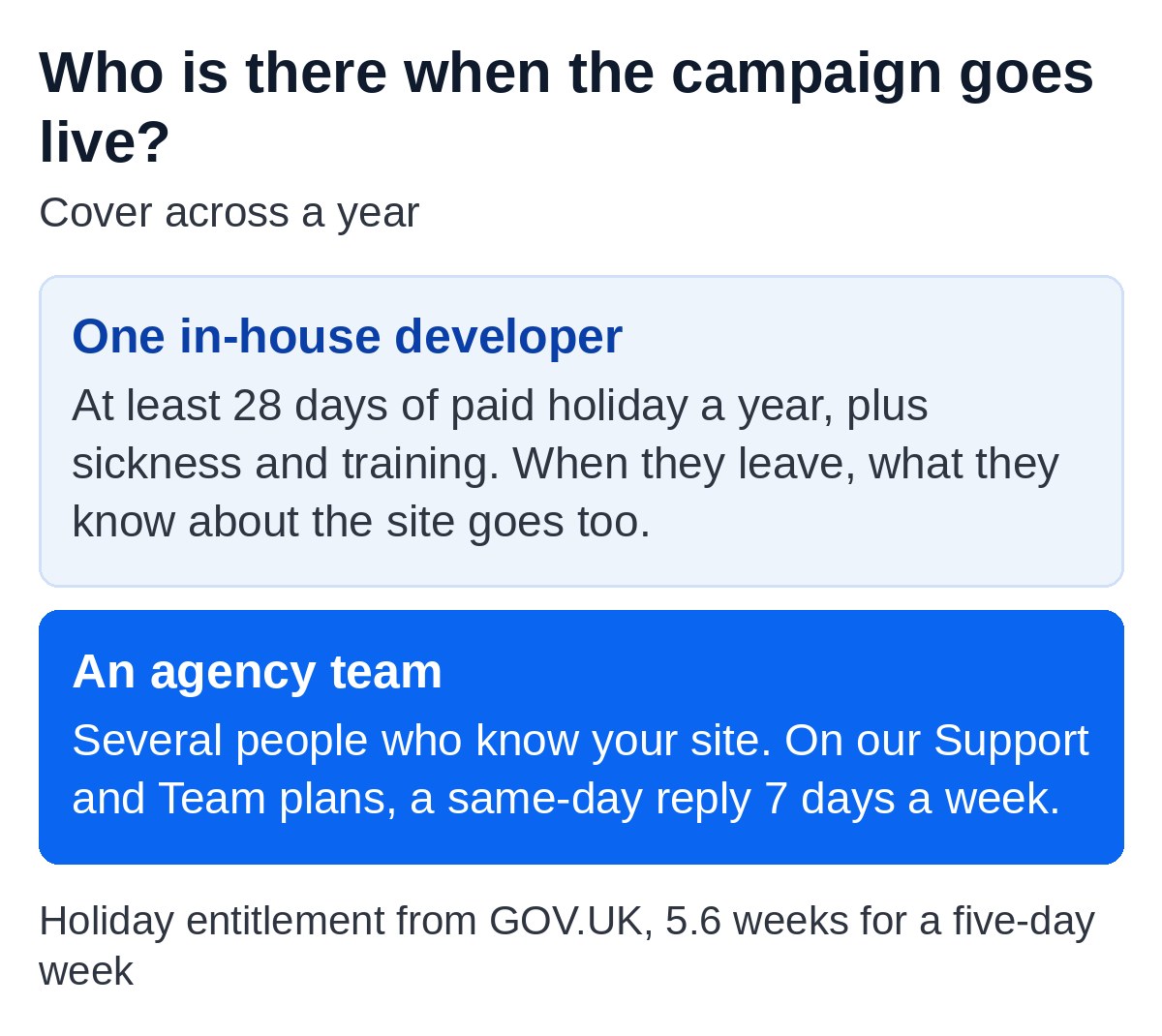
Agencies aren’t automatically fast, though. Some run every small change through tickets and quotes, which is exactly the slow process you’re trying to escape as the business plans for growth. Ask any agency for its reply times in writing, and how communication works day to day. With our website support on the Support and Team plans you get a same-day reply 7 days a week, weekends included, and the delivery date for each job is agreed before we start.
When In-House Development Makes Sense for a Growing Business
Best for businesses where the website or a web app is the core product, or where there’s a steady full-time backlog of development work that will still be there in a year.
If you’re building software that customers log into, running a large shop with constant new features, or you already have several people writing code, bringing the role in-house makes sense. They sit with the product people, build deep knowledge of the code and work to your long-term goals every day. You keep direct control over priorities, which is hard to match from outside, and the role can scale with demand as the company grows.
Even then, plenty of in-house teams use an external partner alongside them for hosting, security and overflow. That hybrid model works well and adds capacity without another person on the payroll.
When an Agency Is the Better Partner for a Marketing Team
Best for businesses without technical people of their own, whose website work peaks around campaigns, launches and events.
Most departments like yours don’t need someone writing code for a full working week, every week. They need a landing page live by Thursday, a form that’s stopped sending fixed today and tracking they can trust, and then a quiet fortnight. A good agency has the flexibility to handle that, and you get design, development, SEO and tracking expertise that would take several hires to cover in-house.
The other benefit is that you stop worrying about the parts nobody sees until they break, like hosting, backups, security updates and uptime monitoring. We keep Glampville’s booking site ready for its busiest day of the year, and on Glastonbury ticket day it had over 13 times its usual Google visits (see the Green Yurts case study). That’s the kind of day nobody can afford to be waiting on a fix. It’s what our website support for marketing teams is built around.
What About a Freelance Web Developer?
Best for a single project with a clear brief where a few days’ wait for a reply won’t cost you anything.
Freelancers can be excellent value for defined web projects. The median day rate in UK contract adverts for the role was £438 over the six months to 24 November 2026, according to ITJobsWatch, from a small sample of 13 rates. The risk is availability. A freelancer has other clients, so a quick change can wait behind someone else’s project, and if they move on you’re starting again with someone new. A small agency avoids that, because the knowledge of your site sits with more than one person.
Should I Hire a Web Developer or Use an Agency?
Bring someone in-house if you can describe a full week of development work for every week of the next year. If you can’t, use an agency and keep the budget for the campaigns themselves.
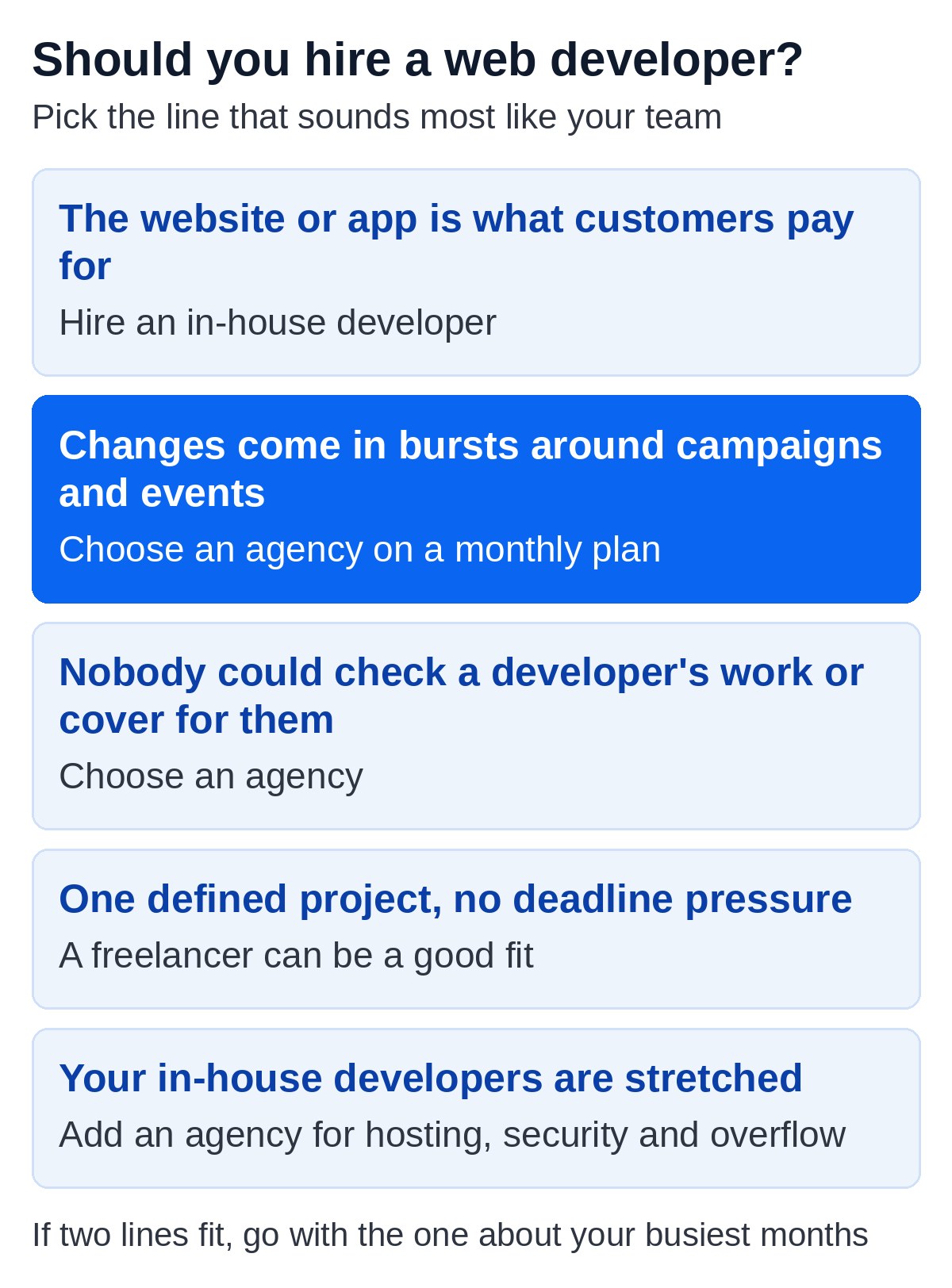
- If the website or app is what customers pay for, go in-house.
- If changes come in bursts around campaigns and events, choose an agency on a monthly plan.
- If nobody could check the work or provide cover, choose an agency.
- If you have one defined project and no deadline pressure, a freelancer can be a good fit.
- If your own development teams are stretched, add an agency for hosting, security and overflow.
Not sure what your site needs yet? Our free website audit checks your website, forms, tracking and speed and sends you a clear report within one working day, so you can see how much development work there really is before you decide who should do it.
How We Compared
This is a desk comparison of agency vs in-house options on price, cover and control for a UK business, checked on 24 November 2026. Salaries and day rates come from ITJobsWatch’s figures for UK job adverts in the six months to that date. Employer National Insurance, pension and holiday rules come from GOV.UK. Agency figures are our own published plan prices and terms.
Frequently Asked Questions
Is it cheaper to use an agency or hire in-house?
For most businesses without their own technical people, an agency is cheaper. One person on median UK pay costs about £55,100 a year once employer National Insurance and pension are added, before equipment or recruitment. An in-house role only starts to make financial sense with a steady, full-time development workload. Our Team plan is £750 a month plus VAT.
How much do web developers earn in the UK?
The median in UK web developer job adverts was £47,500 a year in the six months to 24 November 2026, according to ITJobsWatch. WordPress roles had a lower median of £38,750 from a smaller sample. Contract roles had a median day rate of £438.
Should I use a freelancer, an agency or in-house?
Go in-house when the website is your product or there’s full-time development work every week. Use a freelancer for a single defined project without a tight deadline. Use an agency when changes come in bursts and you need them done quickly, with hosting, security and holiday cover handled for you.
Can an agency work alongside our in-house staff?
Yes, and mixing agency and in-house work is a common setup. An agency can look after hosting, backups, security and updates, take on overflow at busy times and add skills you don’t have, such as design, tracking or SEO. Your own people stay focused on the product work only they can do, and you stay in control of what gets done and when.
Do we own our website if an agency looks after it?
You should, so check the terms before you sign. With us, you keep full control of your site, and your website, domain, content and any custom code we build for it are yours. Our plans are monthly with no minimum term and no exit fee, and if you ever leave we hand everything over.