Hiring a web designer goes well when you check three things before you compare prices. Make sure they’ve built sites like yours, that you’ll own the domain, hosting and content outright, and that you know what the site will cost to look after once it’s live. The questions below cover all three. Ask them in your first call and get the answers in writing, whoever you hire.
This guide is for marketing and events teams without their own developer. It works whether you hire a freelance web designer, an agency or us.
Freelance web designer, agency or website builder?
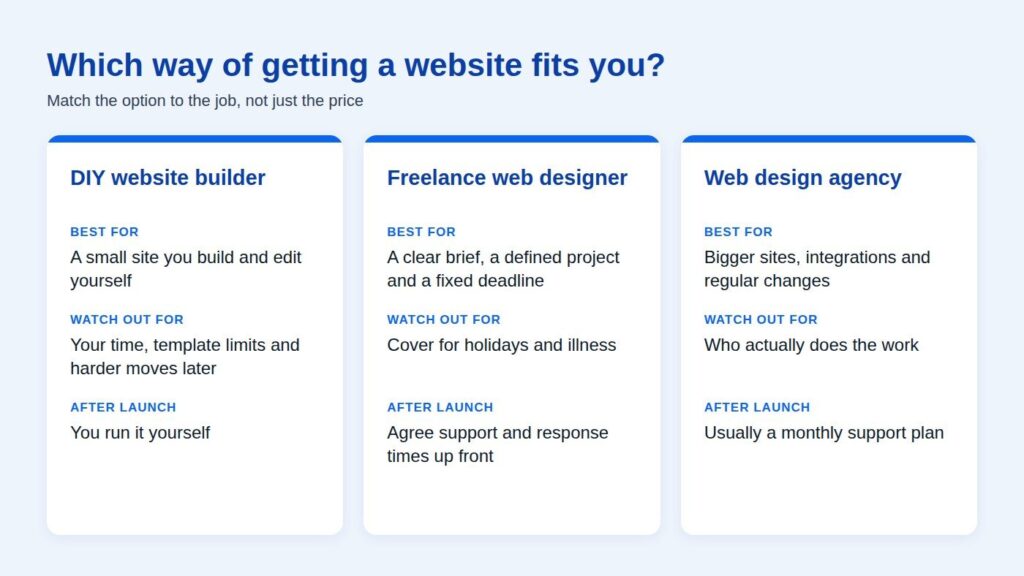
Before hiring a web designer, decide what kind of help you actually need. Platforms like Wix or Squarespace are fine for a simple brochure site you’ll run yourself. A freelance web designer suits a clear, small project. An agency or web team that offers web design and development makes more sense when the site is business critical, needs integrations or will change every month.
| Option | Best fit for | Watch out for |
|---|---|---|
| DIY builder (Wix and similar) | A small site you’ll build and edit yourself, on a tight budget | Your time, template limits and harder moves to another platform later |
| Freelance web designer | A defined project with a clear brief and a fixed deadline | Holidays, illness and what happens if the freelancer stops taking work |
| Web design agency | Bigger sites, custom website design, integrations and tight launch dates | Who actually does the work, and whether they stay after launch |
| In-house web designer | Teams with enough work to keep someone busy full time | Salary, cover when they’re away and no one to check their work |
To be fair to every option, plenty of businesses do well building a website without a designer. The trouble usually starts when the site has to do more than it was built for, like taking event bookings or sending leads to a CRM. Pick the option that’s the best fit for your specific needs, not the one with the lowest price.
Web designer, web developer or UX designer?
The job titles overlap, so it helps to know who does what. A web designer focuses on layout, look and how each page guides the visitor. A web developer handles the website development, connects forms and tools, and keeps the code fast and secure. A UX designer studies the usability of a website and plans user experience design around it, while user interface design (UI design) covers the buttons, menus and screens themselves. Bigger web development projects, like booking systems or web apps, need a developer more than a designer.
Graphic design and logo design are separate skills again. Many web designers can do some of each, but ask. If you need a new logo as well as a new website, find out who’s doing it and whether it’s in the price.
For most marketing teams, the right web designer is one with development help on the same team. Design and layout, build and support done by the same people means fewer handovers and fewer things lost in between.
Write a short brief before you hire a web designer
Tell any web designer “just make me a website” and you’ll get a blank stare, or a site that doesn’t fit. Whether you’re building a new website from scratch or replacing an old one, start with a brief. A one-page brief saves time, stops quotes being wildly different and makes it much easier to compare like for like.
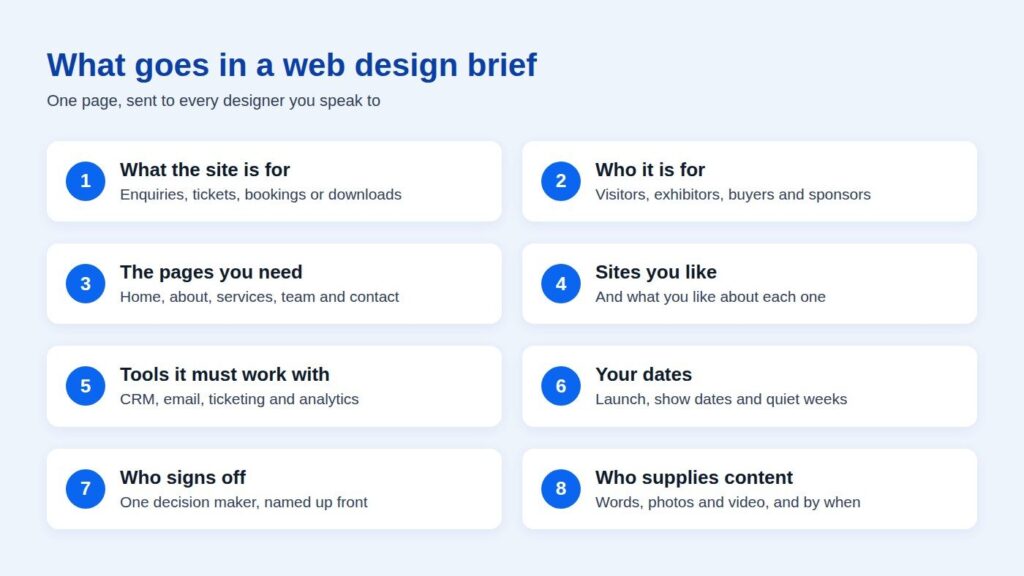
- What the site is for. Enquiries, ticket sales, exhibitor bookings, downloads. Pick the one or two that matter most.
- Who it’s for. Visitors, exhibitors, buyers, sponsors, and what each of them needs to find quickly.
- The pages you need. Home, about, services or programme, team, contact, plus anything specific to your business. Our guide to the parts of a website helps here.
- Sites you like. Start with your competitors, then look at design galleries like Awwwards. Note what you like about each one, not just the name.
- The tools it must work with. Your CRM, email platform, booking or ticketing system and analytics.
- Your dates. Launch date, show dates and any weeks when nothing can change.
- Who signs off. One decision maker saves weeks of back and forth.
Questions to ask before hiring a web designer
These are the questions to ask a web designer in your first call. Good designers will be glad you asked. If someone gets vague or defensive, that tells you something too.
1. Can I see websites you’ve built like ours?
Ask for live sites, not just screenshots, and ideally something close to your sector or your size. Click around them on your phone. Then ask if you can speak to one or two of those clients about how the project went and what happened after launch.
2. Who will actually do the work?
Some web designers subcontract the build to another web designer or developer. That’s not always a problem, but you should know who’s designing, who’s developing and who you’ll speak to when something breaks.
3. What’s included in the price, and what costs extra?
Ask for a written quote that lists pages, features, rounds of changes, copywriting, images, stock photo licences, paid plugins and hosting. The cheapest quote is often the one with the most left out.
4. How long will it take, and what do you need from us?
Most delays come from content, not design. Agree who writes the words and supplies the photos, and the dates for each checkpoint. If you’re working towards an event, give the designer your show dates on day one.
5. How do approvals and changes work?
Find out how many rounds of changes are included and when you’ll see designs. You want to approve the key page layouts before development starts, not see the whole thing finished and be asked “what do you think?”
6. What will you build it on, and can my team edit it?
Ask which platform they’ll build the site on (WordPress, a builder or something custom) and why. Then ask to see the editor. Your team should be able to change text, images, dates and prices without calling the designer every time.
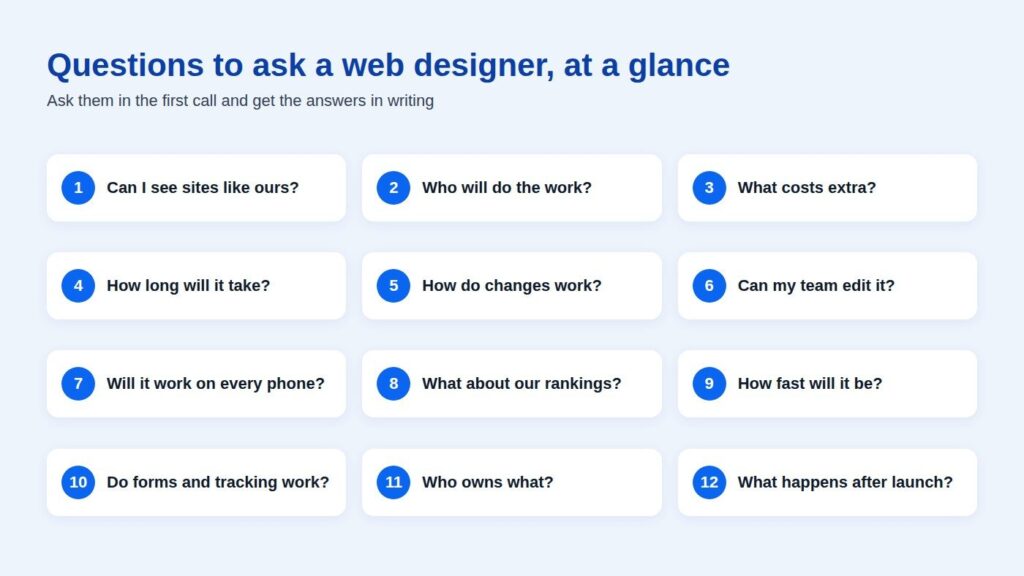
7. Will it work well on phones and for every visitor?
Every site should use responsive design, so pages adapt to the screen. Ask how they test on phones and whether they check accessibility, such as text contrast and forms that work with a keyboard. Our article on responsive web design explains why it matters.
8. What happens to our Google rankings?
If you already have a website, this one matters most. Ask how they’ll keep the pages that rank, carry across titles and descriptions, and set up a 301 redirect from every old address that changes. Google’s site move guidance says permanent redirects don’t cause a loss in PageRank, so a designer who skips them is costing you traffic for no reason. Our website migration page covers what an SEO-safe move involves.
9. How fast will the site be?
Ask what speed they’ll aim for and how they’ll prove it. Google’s Core Web Vitals give a fair benchmark. Pages should show their main content within 2.5 seconds, respond to a tap within 200 milliseconds and keep layout shift to 0.1 or less, measured at the 75th percentile of visits. More on that in our Core Web Vitals guide.
10. Will our forms, tracking and CRM work on day one?
A beautiful site that loses enquiries is a bad site. Ask who connects the forms to your inbox and CRM, who sets up analytics and conversion tracking, and how it’s all tested before launch.
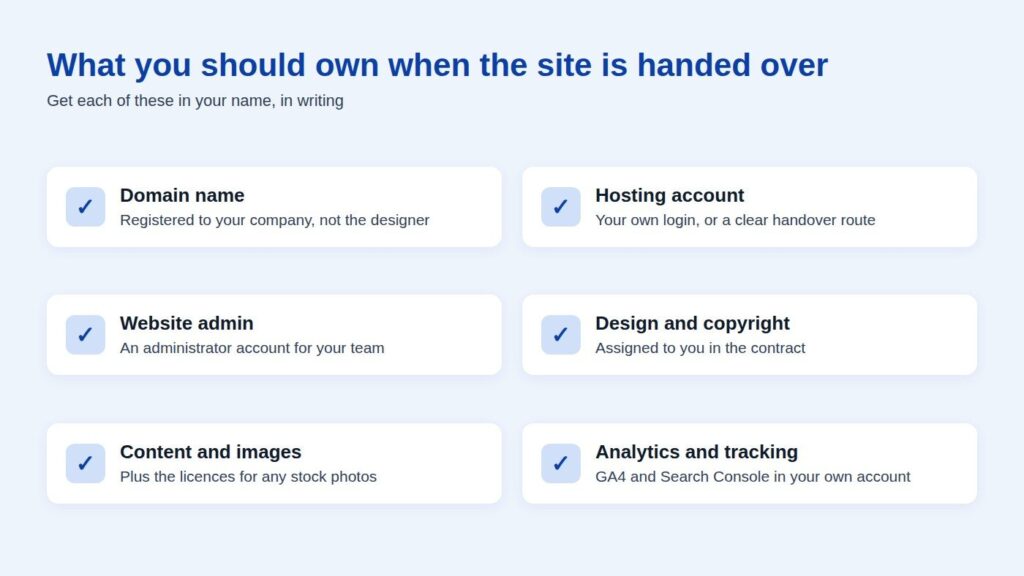
11. Who owns the website, the domain and the design?
Ask for the domain to be registered in your company’s name, with your own logins to the hosting and the site’s admin. Get ownership of the design and content in the contract too. Under UK law the author of a work is the first owner of its copyright unless they’re your employee, and an assignment of copyright only takes effect in writing, signed by the person assigning it. Paying for the site doesn’t automatically make you the owner, so put it in the agreement.
12. What happens after launch, and what does it cost?
This is the question most people forget. A website needs hosting, updates, backups, security and changes for as long as you have it. Ask who does that, how quickly they reply and what it costs, before you sign for the build.
What ongoing website support costs look like
The build is a one-off cost. Looking after the site is a running cost, and it’s usually where the surprises are. Whoever you hire, you’ll pay for some mix of these.
- Domain and hosting. Every site needs both, and cheap hosting tends to be slow hosting.
- Updates and security. WordPress, themes and plugins need regular updates, checked so nothing breaks.
- Backups. Taken automatically, stored away from the server and tested so they actually restore.
- Changes. New pages, event updates, landing pages and fixes. For most teams this is the biggest cost over the life of the site.
- Emergencies. A form that stops sending or a site that goes down the week before a show.
Designers usually charge for this in one of three ways. Pay as you go is cheapest when nothing happens, and most expensive when something does. A monthly plan gives you a fixed cost and someone who already knows your site. Doing nothing is free right up until it isn’t.
For reference, here’s how our website maintenance plans work, whoever built your site. Care is £150 a month plus VAT for hosting, backups, weekly updates, security and small fixes. Support is £350 a month plus VAT and adds about 3 hours of changes a month (unused hours roll over for up to 3 months) and same-day replies 7 days a week. Team is £750 a month plus VAT, with changes and integrations as you need them within fair use and a named contact. Every plan is monthly with no minimum term, and moving your site onto our hosting is free.
Red flags when hiring a website designer
- They want to register the domain in their own name.
- They won’t give you admin access to your own site.
- They quote a price without asking what the site needs to do.
- They guarantee first place on Google. No one can.
- There’s no written contract or scope.
- Nobody can tell you how backups and updates will be handled after launch.
Common questions about hiring a web designer
How much does it cost to hire a web designer?
It depends on the number of pages, custom features, integrations and who writes the content, so quotes for the same site can vary a lot. Send the same brief to two or three web designers and compare written quotes line by line. Then add the monthly cost of looking after the site, because that runs for as long as you have it.
Is it worth hiring a professional web designer?
If your website brings in enquiries, bookings or sales, usually yes. A professional website designer should save your team time, avoid the mistakes that lose rankings and leads, and give you a site that’s easier to run. If it’s a small site you’ll edit yourself, a DIY builder may be all you need.
How do I find the best web designer for my business?
Ask people in your network who they use and whether they’d hire them again. Look in the footer of sites you like, since many designers credit their work there. If you’re looking for a web designer quickly, freelance platforms like Upwork help you find and hire freelancers, but check portfolios and references just as carefully.
Should I hire freelancers or a web design agency?
A freelance designer is a good fit for well-defined web projects with a clear brief. An agency offering full web design services is usually better when the site is central to your marketing, needs regular changes or has to be looked after properly once it’s live.
Get your current site checked first
If you already have a website, find out what’s working before you brief anyone. Our free website audit checks speed, SEO, security, forms and tracking, and tells you in plain English what needs fixing. It’s a useful brief for any designer you speak to. If you’d like us to design it, our web design page shows how we work.