I first put this page together in 2021, when it was a page of Google My Business statistics and Google Business Profile was still called Google My Business. A lot of sites still link to it, so I’ve rewritten it with current data. Every figure below was checked against its original source on the date above, and each one links to (or names) where it came from. Where a survey only covers the US, I’ve said so, and I’ve added UK figures wherever a reliable source exists.
Key Google Business Profile statistics at a glance
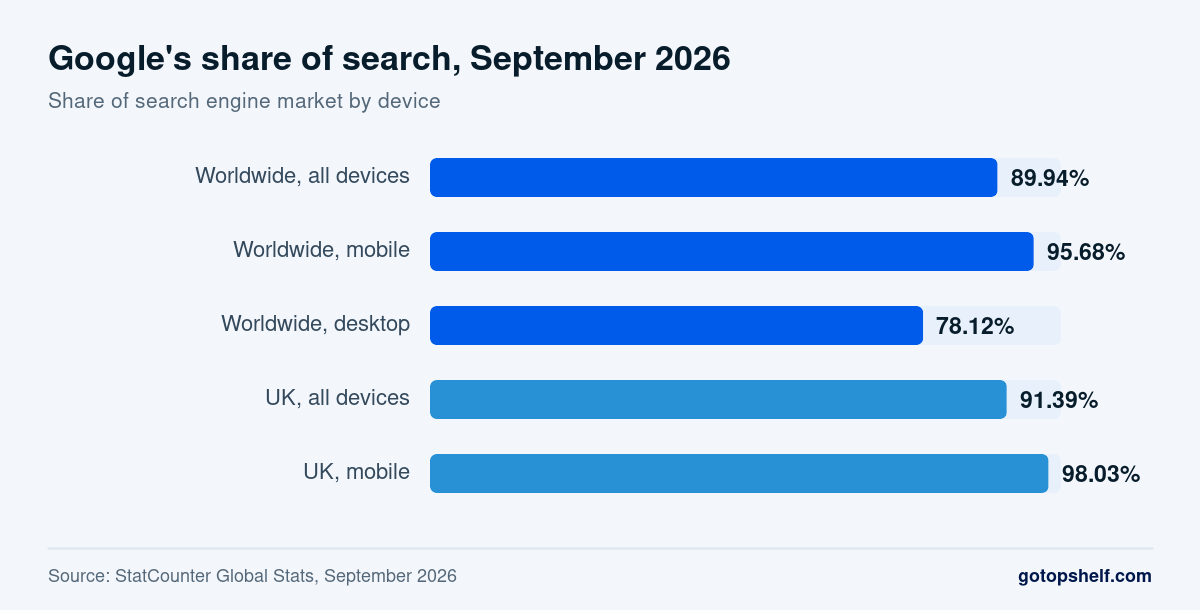
- Google has an 89.94% share of worldwide search and 91.39% in the UK (StatCounter, September 2026), so most consumers use Google first.
- Google says it handles more than 5 trillion searches a year, and that 15% of the searches it sees every day are new.
- 78% of UK online adults used Google Maps in May 2025, up from 69% in 2023 (Ofcom).
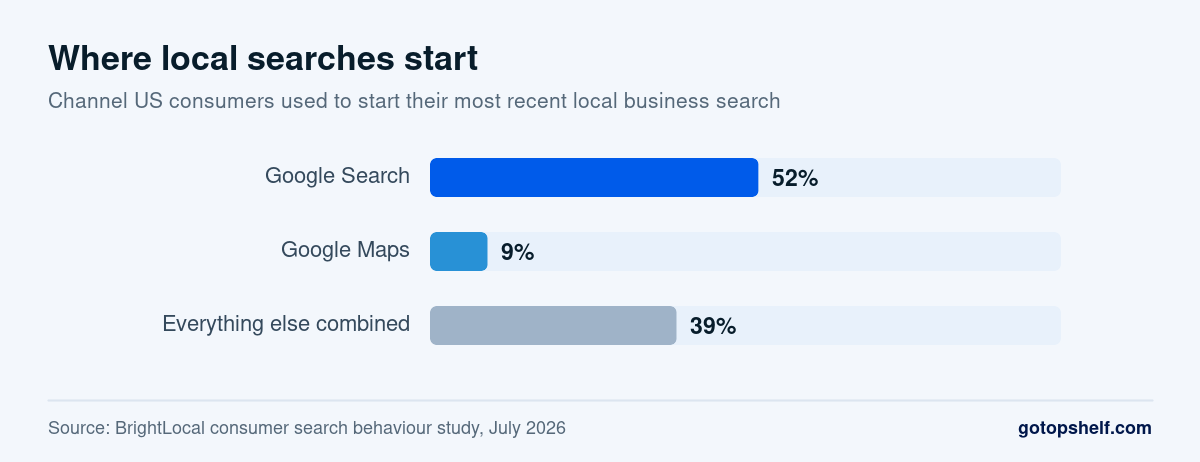
- 61% of US consumers started their most recent local business search on Google, either Search (52%) or Maps (9%) (BrightLocal, 2026).
- 85% of US small businesses have a Google Business Profile, but only 35% keep it active (BrightLocal, 2026).
- 68% of consumers will only use a business rated four stars or more, up from 55% a year earlier (BrightLocal, 2026).
- Google published more than 1 billion reviews on Maps in 2025 and removed 13 million fake Business Profiles.
- 45% of consumers have used ChatGPT or another AI tool for local recommendations, up from 6% the year before.
Google search statistics in 2026
Google is still the default place people search, and the number of Google searches keeps growing. StatCounter puts its worldwide share of the search engine market at 89.94% across all devices in September 2026. On mobile it’s 95.68%, and on desktop it’s lower at 78.12%, with Bing on 14.62%. In the UK Google’s share is 91.39% overall and 98.03% on mobile, so for most UK businesses mobile search more or less means Google.
Google rarely publishes volume figures now. The latest one is more than 5 trillion searches a year, shared in March 2025 and the first annual figure since “more than 2 trillion” in 2016. Any “searches per day” number you see is someone dividing that figure, not something Google has published. Google’s How Search Works page still says 15% of the searches it sees every day have never been searched before.
In terms of visits, Similarweb estimates google.com had about 85.2 billion visits in September 2026, which keeps it the most visited website in the world. That figure is a modelled estimate rather than Google’s own data, so I’d treat it as a rough guide. In its Q3 2026 results Google said year-over-year growth in search queries was the highest it has been in five years.
Mobile search statistics
The old version of this page quoted a figure of 63% for mobile traffic, which I couldn’t trace back to a source, so it’s gone. The current StatCounter platform data shows mobile devices generated 58.99% of worldwide web page views in September 2026, with desktop on 39.26% and tablet on 1.76%. The UK is more balanced, with mobile on 53.56% and desktop on 41.78%.
Local searches are more mobile than the web as a whole, and that includes profile views. BrightLocal’s 2026 consumer search study found 73% of US consumers’ most recent local searches started on a mobile phone. In practice that means your Business Profile and your website need to work on a small screen first, because that’s where most people meet them. I’ve written more about this in why websites are focusing on mobile first.
Google Business Profile listing statistics
Most small businesses have a profile, but plenty don’t look after their business information once it’s set up. BrightLocal’s 2026 small business report found 85% of US businesses with 1 to 50 staff have a Google Business Profile, and 63% manage it themselves. Only 35% said they maintain an active presence on it, and only 51% respond to reviews.
That neglect costs customers. In BrightLocal’s decision study, 20% of local searchers were put off by missing or incorrect information, 16% by a listing with no photos and 16% by a listing that looked abandoned or unclaimed. 52% looked at a business during their most recent search and then decided not to contact it.
When a profile does its job, the engagement it brings in is good quality. Invoca’s 2026 call data, based on more than 70 million phone calls, found calls from Google Business Profiles turned into sales leads 43% of the time, ahead of paid search at 39% and organic search at 36%.
Google is also policing profiles much harder, which affects which businesses appear at all. In its 2025 Maps trust and safety update, Google said it removed more than 13 million fake Business Profiles and blocked 79 million inaccurate or unverified edits during the year.
Local search, Google Maps and map pack statistics
Google is where local searches start. BrightLocal found 52% of US consumers began their most recent local business search on Google Search and another 9% on Google Maps. Across the whole journey, 71% used Google Search at some point, and 75% used more than one channel. 84% had searched online for a local business in the previous three months.
In the UK, Ofcom’s Online Nation 2025 report found 82% of online adults used Google Search in May 2025 and 78% used Google Maps, up from 69% in 2023. Google Maps was the third most used smartphone app in the UK, reaching 77% of adult smartphone users, while Apple Maps reached 15%.
People don’t simply click the top result either. Only 6% said they “just click the top result”, and 44% check the address or distance before clicking, rising to 48% for trades and home services. Proximity is a big factor in the Maps rankings too. In Whitespark’s 2026 Local Search Ranking Factors survey of local SEO specialists, the primary Business Profile category, proximity to the searcher, keywords in the business name, a physical address in the city searched and being open at the time of the search were rated the top five local pack factors.
Paid placements are taking more of the local results page. Local SEO firm Sterling Sky tracked paid ads inside the local 3-pack rising from about 1% of its mobile ranking reports at the start of 2025 to almost 22% by December, while Local Services Ads went from roughly 11% to 31% of tracked queries.
Google review statistics and what customers expect
Google reviews are still the part of a profile that does the most persuading. BrightLocal’s Local Consumer Review Survey 2026 (1,002 US consumers) found 97% of consumers read online reviews and 41% always read them when looking at businesses, up from 29% in 2025. Google is still the most used review site, although the share using it to read reviews fell from 83% to 71%, while Apple Maps nearly doubled from 14% to 27%.
The bar for star ratings has gone up. 68% of consumers will only use a business with four stars or more, up from 55%, and 31% want 4.5 stars or more, up from 17%. Volume and recency matter as well: 47% won’t use a business with fewer than 20 reviews, and 74% only care about reviews written in the last three months.
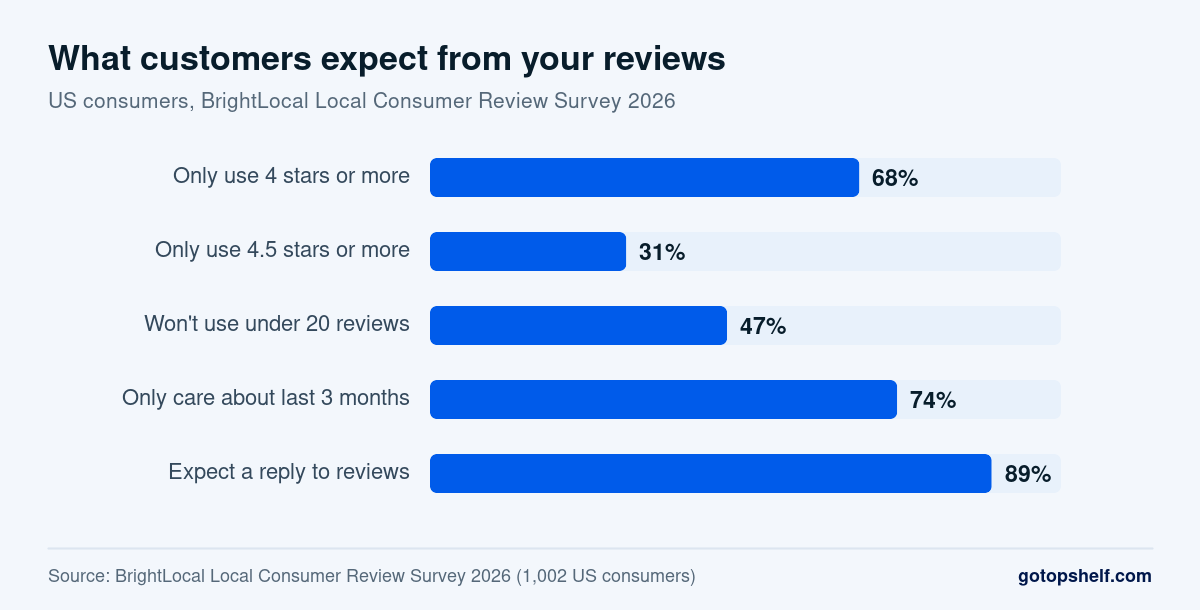
Replying is part of it too. 89% of consumers expect a response to their reviews, 32% want one by the next day (up from 18%) and 81% within a week. 80% say they’re likely to use a business that responds to all its reviews, but generic or templated replies put off 50%. After reading positive reviews, 54% go on to visit the business website, up from 32% in 2019, which is a good reason to make sure that website is worth landing on. My guide to landing page SEO covers the basics.
On the volume side, Google says it published more than 1 billion reviews on Maps in 2025 and blocked or removed more than 292 million that broke its policies. Google Maps has more than 500 million contributors.
AI search statistics and local businesses
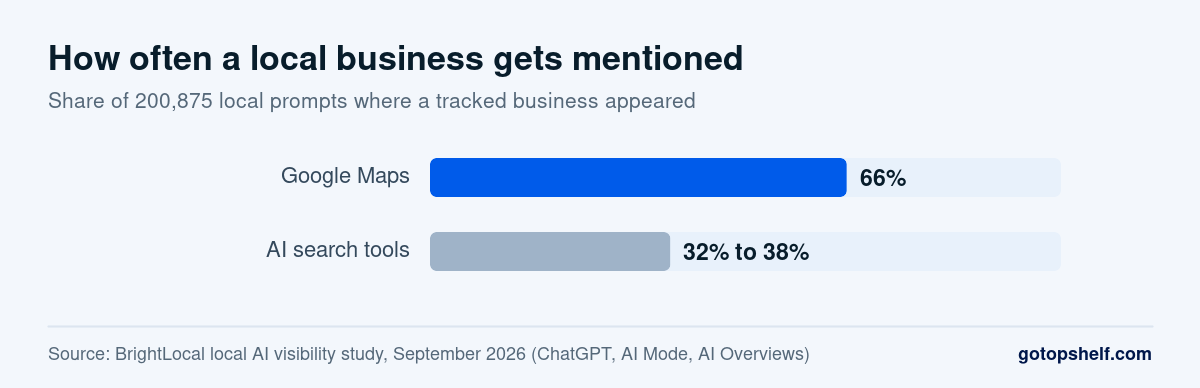
AI is changing how people find local businesses, but Google’s local results still carry most of the weight. In BrightLocal’s local AI visibility study of 200,875 local prompts, Google Maps mentioned a tracked business 66% of the time, compared with 32% to 38% for ChatGPT, AI Mode and AI Overviews. AI results also changed a lot between repeat searches, overlapping only 20% to 33%. Business websites made up 93% of the unique sources AI tools cited, so your own site matters here as much as your profile.
More people are trying AI for local recommendations. 45% of consumers used ChatGPT or another AI tool for this in 2026, up from 6% the year before, and 82% read AI-generated review summaries. Very few rely on them alone though. Of people who started a local search with AI, only 2% used it as their only channel and 43% went on to check Google.
AI summaries do reduce clicks. Pew Research Center found US Google users clicked a traditional result on 8% of visits when an AI summary appeared, compared with 15% when it didn’t, and clicked a link inside the summary on just 1% of visits. Semrush found AI Overviews appeared on 15.69% of keywords in November 2025, having peaked near 25% in July. Google said in its Q2 2026 results that AI Mode had passed 1 billion monthly users.
Maps itself now has a conversational side. Google launched Ask Maps, a Gemini-powered chat in Google Maps, in March 2026, drawing on more than 300 million places and reviews from over 500 million contributors. It launched in the US and India first. In the UK, Ofcom (citing YouGov) reports that 53% of people say they often see AI summaries in search.
Google Business Profile feature changes since 2024
If you set your profile up a few years ago, a fair bit has changed since. These are the changes I could confirm on Google’s own pages, so treat this section as a checklist if you haven’t looked at your profile for a while:
- Chat and call history were switched off on 31 July 2024. Calls and other interactions are still counted in the performance report, and Google’s help page explains how calls, direction requests and website clicks are measured.
- Owners can manage a profile in the Gemini app, including updating hours, drafting review replies and posts, and checking performance and search keywords.
- Questions and answers are only available for some business categories and regions.
- Short names (g.page links) can no longer be created or edited.
- Businesses can create a review link or QR code to send to customers. Incentivised reviews are not allowed.
- Profiles caught with fake reviews can have new reviews blocked and a warning shown to the public. Since April 2026 Google also pauses new reviews when a profile is hit by a spike of spam reviews.
- Video verification is Google’s recommended way to verify a profile where it’s available.
- Profiles can be linked to Google Analytics, so you can see listing interactions next to your website data.
What this means for customer calls and visits
The data points the same way it did in 2021, just more strongly. Customers find local businesses on Google, they judge them on the profile and reviews they see there, and then a good number of them click through to the website. A profile that looks abandoned, or a website that doesn’t load properly on a phone, loses people at the last step.
Whether you do your own marketing or have someone helping, I’d keep it simple. Make sure your business hours, contact details, business descriptions and photos are correct, ask happy customers for reviews and reply to all of them, and check that the page your profile links to works well on mobile and tells people what to do next. If your website is the weak link, our website support and development service is there to help with exactly that.
Sources and method
Every figure on this page was read on its original source page on 29 October 2026. I haven’t used figures I couldn’t trace to an original study or official page, which is why several statistics from the 2021 version (such as the “84% of searches are discovery searches” and Think with Google’s near-me figures) have been removed. Most consumer surveys here cover the US, as noted. UK figures come from Ofcom and StatCounter. Sources used: StatCounter Global Stats; Google (The Keyword blog, How Search Works and Business Profile help pages); Ofcom Online Nation 2025; BrightLocal (Local Consumer Review Survey 2026, consumer search behaviour studies, small business report and local AI visibility study); Pew Research Center; Semrush; Similarweb; Invoca; Whitespark Local Search Ranking Factors 2026; Sterling Sky. You’re welcome to use any of the statistics or charts here, and a link back to this page is appreciated.